


Close Menu
    Facebook X (Twitter) Instagram
    • Privacy Policy
    • Terms Of Service
    • Legal Disclaimer
    • Social Media Disclaimer
    • DMCA Compliance
    • Anti-Spam Policy
    Facebook X (Twitter) Instagram
    Brief ChainBrief Chain
    • Home
    • Crypto News
      • Bitcoin
      • Ethereum
      • Altcoins
      • Blockchain
      • DeFi
    • AI News
    • Stock News
    • Learn
      • AI for Beginners
      • AI Tips
      • Make Money with AI
    • Reviews
    • Tools
      • Best AI Tools
      • Crypto Market Cap List
      • Stock Market Overview
      • Market Heatmap
    • Contact
    Brief ChainBrief Chain
    Home»AI News»AI Interview Series #4: Transformers vs Mixture of Experts (MoE)
    AI Interview Series #4: Transformers vs Mixture of Experts (MoE)
    AI News

    AI Interview Series #4: Transformers vs Mixture of Experts (MoE)

    December 5, 20253 Mins Read
    Share
    Facebook Twitter LinkedIn Pinterest Email
    coinbase


    Question:

    MoE models contain far more parameters than Transformers, yet they can run faster at inference. How is that possible?

    Difference between Transformers & Mixture of Experts (MoE)

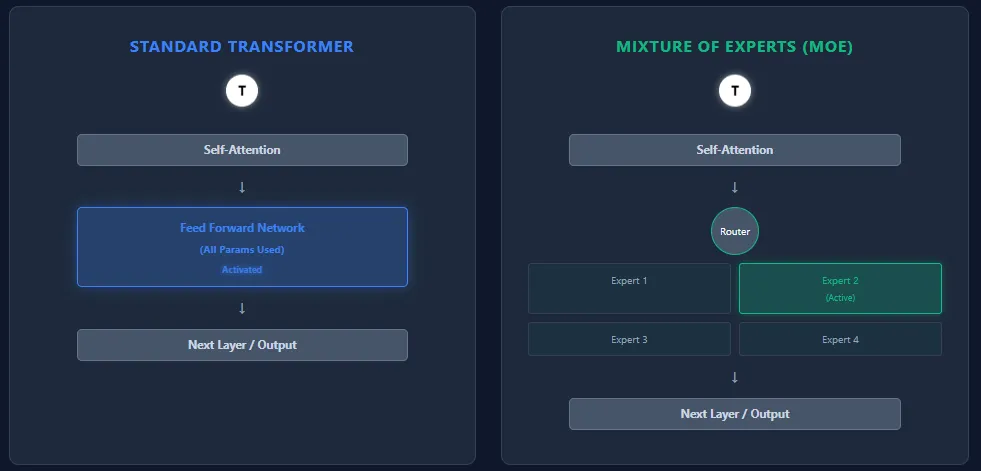
    Transformers and Mixture of Experts (MoE) models share the same backbone architecture—self-attention layers followed by feed-forward layers—but they differ fundamentally in how they use parameters and compute.

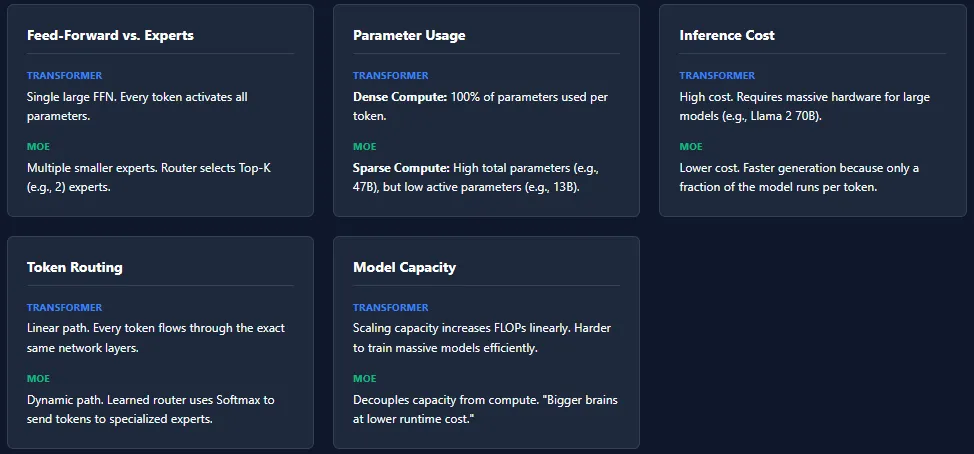
    Feed-Forward Network vs Experts

    • Transformer: Each block contains a single large feed-forward network (FFN). Every token passes through this FFN, activating all parameters during inference.
    • MoE: Replaces the FFN with multiple smaller feed-forward networks, called experts. A routing network selects only a few experts (Top-K) per token, so only a small fraction of total parameters is active.

    Parameter Usage

    • Transformer: All parameters across all layers are used for every token → dense compute.
    • MoE: Has more total parameters, but activates only a small portion per token → sparse compute. Example: Mixtral 8×7B has 46.7B total parameters, but uses only ~13B per token.

    Inference Cost

    • Transformer: High inference cost due to full parameter activation. Scaling to models like GPT-4 or Llama 2 70B requires powerful hardware.
    • MoE: Lower inference cost because only K experts per layer are active. This makes MoE models faster and cheaper to run, especially at large scales.

    Token Routing

    • Transformer: No routing. Every token follows the exact same path through all layers.
    • MoE: A learned router assigns tokens to experts based on softmax scores. Different tokens select different experts. Different layers may activate different experts which  increases specialization and model capacity.

    Model Capacity

    • Transformer: To scale capacity, the only option is adding more layers or widening the FFN—both increase FLOPs heavily.
    • MoE: Can scale total parameters massively without increasing per-token compute. This enables “bigger brains at lower runtime cost.”
    While MoE architectures offer massive capacity with lower inference cost, they introduce several training challenges. The most common issue is expert collapse, where the router repeatedly selects the same experts, leaving others under-trained. 
    murf

    Load imbalance is another challenge—some experts may receive far more tokens than others, leading to uneven learning. To address this, MoE models rely on techniques like noise injection in routing, Top-K masking, and expert capacity limits. 

    These mechanisms ensure all experts stay active and balanced, but they also make MoE systems more complex to train compared to standard Transformers.

    I am a Civil Engineering Graduate (2022) from Jamia Millia Islamia, New Delhi, and I have a keen interest in Data Science, especially Neural Networks and their application in various areas.

    🙌 Follow MARKTECHPOST: Add us as a preferred source on Google.


    Previous articleHow to Build a Meta-Cognitive AI Agent That Dynamically Adjusts Its Own Reasoning Depth for Efficient Problem Solving


    Source link

    aistudios
    Share. Facebook Twitter Pinterest LinkedIn Tumblr Email
    CryptoExpert
    • Website

    Related Posts

    Featured video: Coding for underwater robotics | MIT News

    March 1, 2026

    Anthropic vs. The Pentagon: what enterprises should do

    February 28, 2026

    Poor implementation of AI may be behind workforce reduction

    February 27, 2026

    Nous Research Releases ‘Hermes Agent’ to Fix AI Forgetfulness with Multi-Level Memory and Dedicated Remote Terminal Access Support

    February 26, 2026
    Add A Comment
    Leave A Reply Cancel Reply

    10web
    Latest Posts

    AI Tool Helps Avert Critical XRP Ledger Security Flaw

    March 1, 2026

    Binance Liquidity Supply Revisits 2024 Levels As Tradable BTC Rises — Details 

    March 1, 2026

    Ethereum Smart Accounts Coming in Hegota Fork

    March 1, 2026

    Government Bonds Are Getting Interesting Again

    March 1, 2026

    Bitcoin Crashes as US and Israel Strike Iran, War Begins

    March 1, 2026
    coinbase
    LEGAL INFORMATION
    • Privacy Policy
    • Terms Of Service
    • Legal Disclaimer
    • Social Media Disclaimer
    • DMCA Compliance
    • Anti-Spam Policy
    Top Insights

    Z Score of Bitcoin-to-Gold Ratio Signals ‘Major’ Rally Coming: Analyst

    March 1, 2026

    Featured video: Coding for underwater robotics | MIT News

    March 1, 2026
    bybit
    Facebook X (Twitter) Instagram Pinterest
    © 2026 BriefChain.com - All rights reserved.

    Type above and press Enter to search. Press Esc to cancel.