
Bitcoin miners’ identity is fracturing on four fronts simultaneously: crushed margins, accelerating AI pivots, expanding debt loads, and a treasury sell discipline that no longer holds.
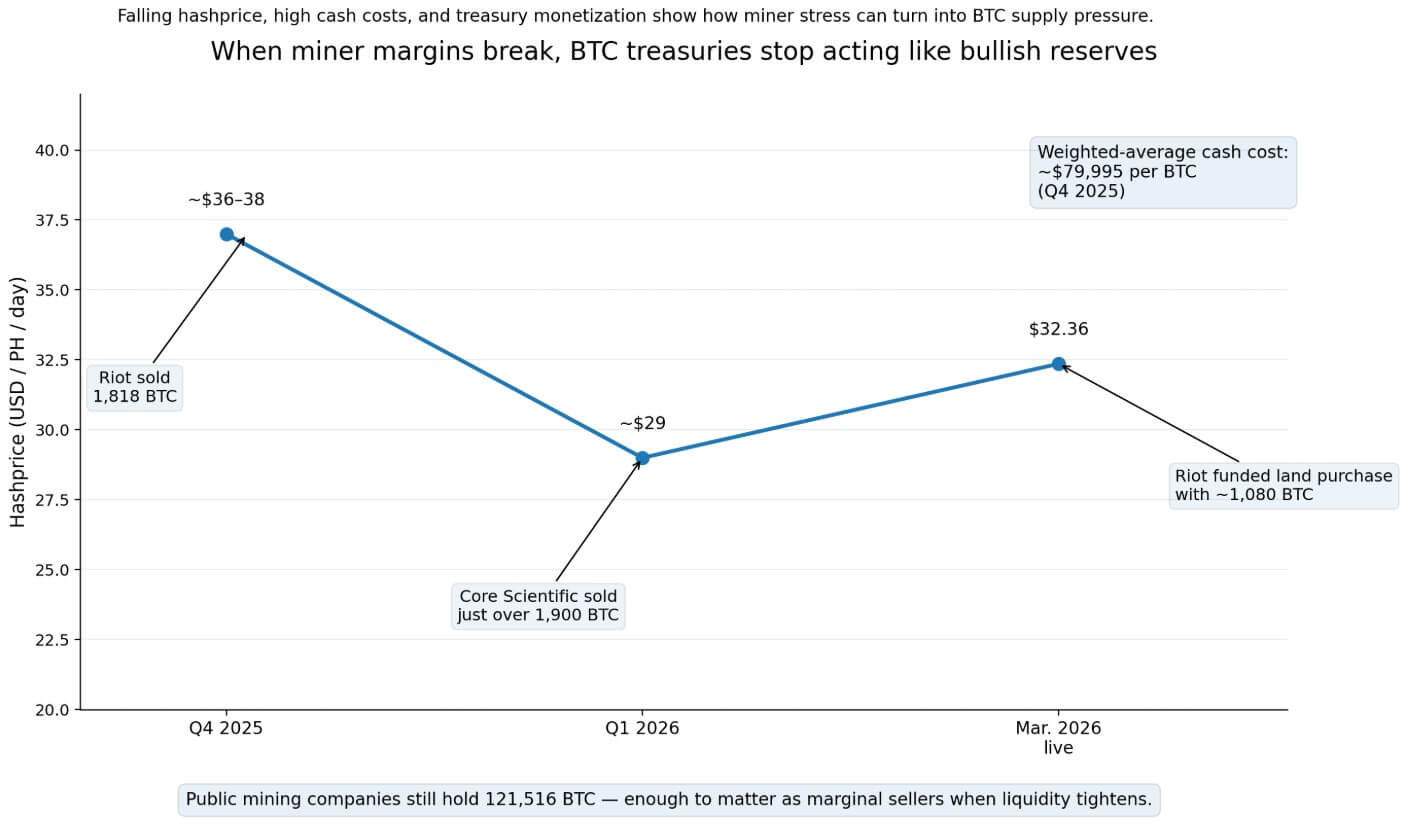
CoinShares’ latest mining report shows public miners’ weighted-average cash cost was roughly $79,995 per BTC in the fourth quarter of 2025. The hash price fell to approximately $36-$38 per PH/s/day in the same quarter, then dropped further to around $29 in the first quarter of 2026.
The network logged three consecutive negative difficulty adjustments, the first such streak since July 2022. The live hash price currently sits around $32.36/PH/day, with fees at just 0.40% of block rewards, and the six-month forward market average hash price is near $30.42.
What miners do under those conditions is where the market structure case begins.

Public mining companies collectively hold 121,516 BTC, worth approximately $8.63 billion, making them meaningful marginal sellers, even after losing their status as the dominant public-company treasury class.
Several have already moved from holding to selling. MARA changed its strategy in 2025 to permit sales of Bitcoin from operations and expanded that in 2026 to include balance sheet BTC.
Riot Platforms sold 1,818 BTC in December 2025 for $161.6 million, Core Scientific sold just over 1,900 BTC in January 2026 for about $175 million, and now holds under 1,000 BTC.
Riot separately funded a 200-acre land purchase at Rockdale entirely by selling roughly 1,080 BTC from its balance sheet.
That behavior runs counter to a persistent retail assumption that miners hold by default and that large miner treasury balances are structurally bullish.
When margins break, miners act like commodity producers managing liquidity, and Treasury policy becomes pro-cyclical, with selling concentrated precisely when BTC is already weak.
The identity split
The fracture described by CoinShares runs deepest through the AI pivot.

The firm says listed miners could derive up to 70% of their revenues from AI by the end of 2026, up from roughly 30% today.
Core Scientific has energized about 350 MW for CoreWeave and targets roughly 590 MW by early 2027. Its revenue in the fourth quarter of 2025 already showed $42.2 million from self-mining, versus $31.3 million from colocation.
Hut 8 signed a 15-year, 245 MW AI data center lease with a $7 billion base-term value. IREN reported $17.3 million in AI Cloud Services revenue, secured $3.6 billion of GPU financing tied to a Microsoft contract, and guides investors toward a $3.4 billion ARR target by end-2026.
TeraWulf says it has signed more than $12.8 billion in long-term customer contracts and completed $6.5 billion in long-term financings in 2025. Riot signed its first AMD data-center lease.
For equity investors, that redefines what a miner stock actually represents. Buying a listed miner now bundles exposure to BTC price, hyperscaler demand, lease execution timelines, retrofit capital expenditure, financing costs, and counterparty quality.
CoinShares described this explicitly as a bifurcation, with AI/HPC-linked names earning valuation premiums over pure-play miners. The stocks share the same ticker symbols, while the underlying businesses have shifted their centers of gravity.
CompanyMining business signalAI/HPC signalDebt / financing signalWhat the stock increasingly representsCore Scientific$42.2M self-mining revenue$31.3M colocation revenue; 350 MW energized; 590 MW targetExpanded financing facilityHybrid mining + data-center executionHut 8Still mines BTC245 MW, 15-year AI leaseLarge long-term infrastructure exposurePower + digital infrastructure platformIRENMining remains meaningful$17.3M AI cloud revenue; $3.4B ARR target~$3.7B convertible notesLevered AI + mining hybridTeraWulfMining still present$12.8B customer contractsHeavy financing and debtAI landlord with mining residualRiotMining-led brandAMD data-center leaseTreasury monetization + expansion capexBTC exposure plus data-center optionalityCipherMining operatorHPC diversification under developmentMulti-billion secured notesLeverage-heavy transition story
Debt load amplifies that divergence. IREN carries nearly $3.7 billion of convertible notes payable as of Dec. 31, 2025. TeraWulf’s balance sheet shows roughly $46.3 million in current long-term debt, $489.8 million in short-term convertibles, $3.05 billion in long-term debt, and $1.58 billion in convertible notes.
Core Scientific expanded its strategic financing facility to $1 billion. Cipher disclosed $3.73 billion in recent senior secured note financing.
Businesses built around those balance sheets care about rates, refinancing windows, build-cost inflation, and customer concentration in ways that pure Bitcoin miners never had to.
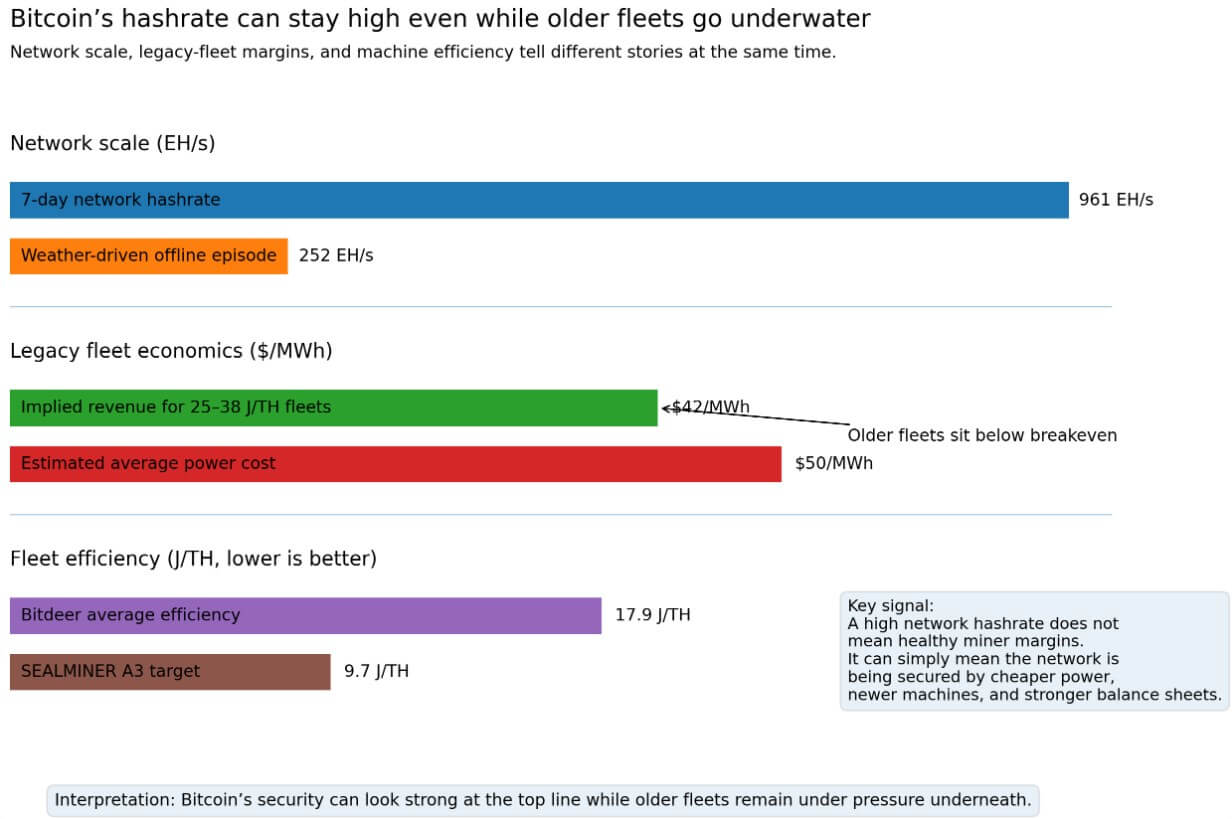
Meanwhile, network hashrate runs at roughly 961 EH/s, a figure the Luxor data puts in sharper context.
Fleets running at 25–38 J/TH were earning about $42/MWh in implied revenue against an estimated network-average power cost of $50/MWh, leaving S19-class hardware in negative gross-margin territory throughout February.
Luxor also documented a 252 EH/s weather-driven offline episode, showing how quickly marginal fleets disappear when economics tighten.
Bitdeer achieved an average miner efficiency of 17.9 J/TH in the fourth quarter of 2025 and is targeting 9.7 J/TH with its SEALMINER A3.
A high hashrate can now coexist with widespread unprofitability in older fleets, meaning a narrower, better-capitalized, more machine-efficient survivor set now secures the network. At the same time, the broader sector stays under strain.
Potential scenarios
If BTC recovers toward the $100,000 range, hash price eases, and immediate treasury stress lifts, the equity winners are the operators that can pair recovering mining margins with credible AI/HPC execution, because those names capture both the BTC recovery and an infrastructure rerating.
Core, Riot, Hut 8, TeraWulf, and IREN all have sufficient disclosed data center ambitions to drive price recovery and widen the gap between hybrid and pure-play names.
In that scenario, the AI pivot transforms from a survival strategy into a valuation catalyst, and the most debt-loaded operators with the strongest contract pipelines earn multiples that pure miners cannot match.
If BTC stays below the stress thresholds CoinShares flagged, hash price holds in the high-$20s to low-$30s, and additional treasury drawdowns normalize across the sector.
Luxor’s February fleet data suggests many legacy machines were already underwater before any further price decline, so that a sustained downturn would accelerate forced shutdowns, reserve monetization, and a transfer of shares toward low-cost, next-generation operators.
The sector’s combined 121,516 BTC in treasuries becomes a supply overhang that activates precisely when BTC spot markets are softest.
At the same time, miners carrying multi-billion-dollar convertible loads face refinancing stress if AI contract execution slips or capital markets tighten.
The most debt-loaded hybrids then absorb headwinds from two directions simultaneously: BTC price and infrastructure build credibility.
The fracture CoinShares’ report documents runs beneath both scenarios.
Miners no longer share a unified BTC appreciation thesis, and some are now selling BTC to fund operations.
Some derive more enterprise value from data-center lease execution than from block rewards.
Some benefit from Bitcoin’s weakness only once weaker rivals shut down, and the difficulty eases, freeing up margin for the survivors.
The companies still securing Bitcoin’s blocks are splitting into forced commodity sellers, debt-funded AI landlords, and a thinning cohort of efficient pure-play operators with the power costs and machine quality to survive without pivoting.
