



Few digital media platforms have made as big an impact as TikTok. But since the late 2010s, TikTok has matured from an experimental short-form video-sharing platform into a cultural (and revenue-sharing) phenomenon. Today, TikTok not only sets the agenda for social media, but the way we create and consume media in general.
In this article, “TikTok Statistics 2025: Users, Growth, and Global Trends,” we get an overview of the platform’s reach and growth. From user growth and demographics to engagement and revenue, this article gives us a sense of the ecosystem the platform has built, as well as its ability to grow, retain, and monetize its international audience.
By looking at user stats by country, regional penetration rates, revenue growth, and daily hours spent on the platform, we can get a sense of the breadth and depth of the growing platform.
While the stats show a widespread platform, we also know that competition is increasing, legislature is shifting, and consumer behavior is becoming increasingly unpredictable. But the platform’s ability to grow in revenue and retain engagement is a clear indicator that the platform is here for the long-haul, and will only continue to set the tone for the cadence of international digital life.

Global TikTok User Growth (2018–2025)
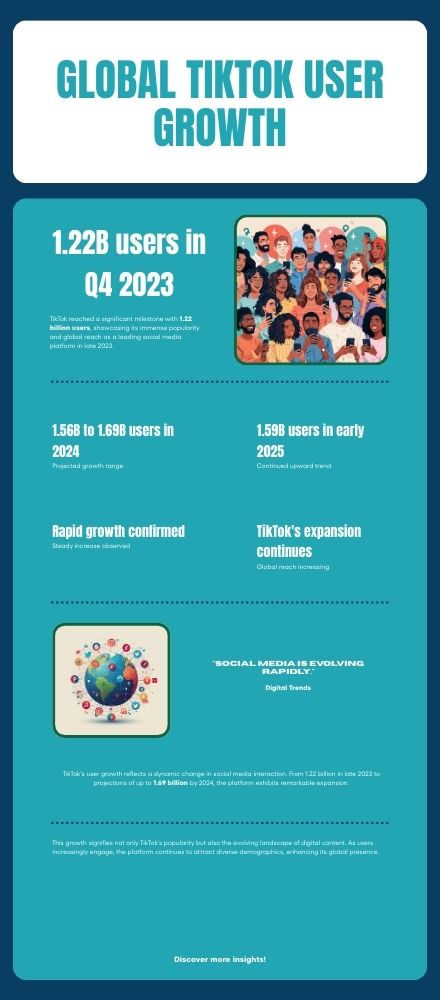
To give you some context, here’s where TikTok was in late 2018: 271 million monthly active users. That’s a significant presence, but, as we know, just the beginning. Fast forward to December 2019, and we’re looking at 508 million monthly active users, before reaching 689 million by July 2020, and eventually topping 1 billion monthly active users in 2021.
These are the latest “official” numbers that TikTok’s confirmed. Beyond this, we only have estimates. For example, according to Statista, DataReportal, and other research outlets, the most recent estimates put TikTok’s monthly active user base at:
- 1.22B in Q4 2023
- 1.56B to 1.69B in 2024
- 1.59B in early 2025
TikTok Monthly Active Users (MAUs) is Global
YearGlobal MAUs (approx.)Evidence / Note2018271 millionCompany figures reported by Reuters (Dec 2018).2019508 millionCompany figures reported by Reuters (Dec 2019).2020689 millionCompany figure (July 2020) via Reuters.20211.0+ billionCompany announcement of 1B MAUs (2021).2022—No official global MAU disclosed; widely estimated but inconsistent, so omitted for accuracy.2023~1.22 billion (Q4)Third-party compilation of MAUs.2024~1.69 billion (Q4 peak)Third-party compilation of MAUs.2025~1.59 billion (Q1)Third-party compilation of MAUs; slight dip vs. 2024 Q4.
My Take on These Numbers
Honestly, this looks like a classic case of a network effect to me, with a few caveats.
During this period, it’s clear that TikTok was just on fire. Both in its own reporting, and through every other report at the time, we can see that the platform’s growth was skyrocketing. Short-form video was the new thing, creators were flocking to the app, the ‘For You’ page algorithm was getting better and better at understanding what users want to see, and it just created a cycle that largely perpetuated itself.
After you reach a billion users, it’s natural that your growth rate slows down a bit. It’s just the law of large numbers; the bigger you get, the harder it is to maintain the same level of growth. Most of the data beyond 2021 is based on estimates from third-party analysts, and while it does look a bit more variable, it appears to suggest that the platform has seen continued growth throughout 2023 and 2024, before flattening out around 2025.
That doesn’t mean that TikTok usage is declining, or that the app is becoming less popular. It likely means that, in order to see continued growth beyond this point, it will need to expand its reach in other markets outside of North America and Europe, while also improving creator monetization options (as supply influences demand) and resolving the various policy and regulatory concerns, especially in the US, but ideally in the EU as well.
If it can manage these elements, it’s possible that these 2024 numbers are not a peak, but a mere waystation on a broader growth curve.
TikTok Users by Country (2025)

Have you ever wondered how many TikTok users there are in each country in 2025?
Looking at the list, we see a mix of what you might expect, and some perhaps less obvious insights.
Obviously, the US is a huge market for TikTok, but there are many other large (and growing) markets that are likely having a major impact on the platform’s overall user base.
Here are the latest estimates for the number of TikTok users in each country:
- United States: 135.79M users
- Indonesia: 107.7M users
- Brazil: 91.75M users
- Mexico: 85.4M users
- Pakistan: 66.9M users
- Philippines: 62.3M users
- Russian Federation: 56.0M users
- Bangladesh: 46.5M users
- Egypt: 41.3M users
- Vietnam: 40.9M users
Estimated TikTok Users by Country (2025)
RankCountryEstimated Users (millions)1United States135.792Indonesia107.703Brazil91.754Mexico85.405Pakistan66.906Philippines62.307Russian Federation56.008Bangladesh46.509Egypt41.3010Vietnam40.90
My two cents:
As an analyst, I think these figures are interesting because they highlight both the opportunity, and the reach that TikTok has. The US is still the biggest single market for TikTok users, but there are several other countries hot on its heels, and in some cases, growing even faster.
Indonesia and Brazil, for example, not only have huge populations but are also very digitally active, which will likely result in different types of creators, content, and monetization strategies emerging in these markets.
It’s also worth noting the presence of Pakistan, the Philippines, and Bangladesh in the top 10. This suggests that South and Southeast Asia are not only important secondary markets, but are central to TikTok’s global ambitions.
That will be important for brands and creators to consider, in terms of incorporating local language content, cultural relevance, and understanding platform behaviors in these regions. Worth noting too that these figures are estimates, compiled from various reports and publicly available data, so they may not all align, or reflect the very latest counts.
As such, they should be taken as directional. But the overall trend is clear. TikTok has a huge, and highly diverse user base, and as it moves forward, we can expect to see even more influence from creators, users, and advertisers in Asia, Latin America, and beyond.
TikTok Penetration Rate by Region (2025)
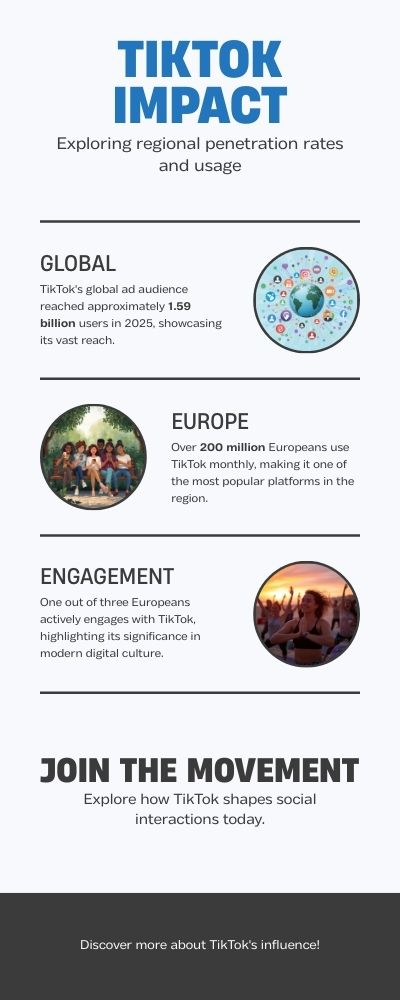
When you ask how “big” TikTok is, I suspect you’re asking about two things at once: the total number of users, and how “embedded” it is into the daily routines of different regions around the world.
TikTok doesn’t publish a simple, consistent “penetration rate” by region, but its ad planning tools do tell us how large the ad audience is in each region.
I’ll use that as our base (which is a standard approach in industry reporting), and I’ll supplement that with the most direct official regional data point we have for 2025.
Definition used here: penetration proxy = TikTok ad audience in Jan 2025, as a proportion of the platform’s global ad audience in each region; plus any regional “% of population using TikTok” data points explicitly attributed to 2025.
Key stats (Jan 2025)
- TikTok’s global ad audience: 1.59 billion users (approx.)
- Europe (company data point): more than 200 million monthly users, equivalent to “one in three” Europeans using TikTok (Sep 2025).
TikTok audience by region (2025)
Region (UN M49 grouping)TikTok ad audience (M)Share of global TikTok audience2025 penetration notesNorthern America1499.3%U.S. adult ad-reach around half of adults; region is highly saturated.Central America1147.1%Large, fast-growing base concentrated in Mexico.Caribbean14.00.9%Smaller absolute base; rising creator ecosystems.South America22814.3%Brazil anchors regional scale; heavy time-spent.Western Europe57.53.6%Part of ~200M Europe-wide MAUs ≈ ~33% of population.Northern Europe37.22.3%Mature adoption; skew slightly female in ad audience.Southern Europe54.33.4%Broad, mainstream use.Eastern Europe1096.8%Large base including non-EU markets.Northern Africa90.95.7%High youth adoption; fast expansion.Western Africa41.52.6%Mobile-first growth dynamics.Middle Africa11.60.7%Smaller absolute audience today.Eastern Africa21.91.4%Rising creator economies.Southern Africa23.41.5%Mixed maturity by market.Western Asia1549.7%High per-capita usage in GCC hubs.Central Asia18.21.1%Early-to-mid adoption curve.Southern Asia1197.5%Significant headroom as connectivity expands.South-Eastern Asia29818.7%Largest regional share; Indonesia leads in time-spent.Eastern Asia (ex-China)42.62.7%Remember: China’s Douyin is separate from TikTok.Oceania10.00.6%High penetration in Australia/New Zealand despite small populations.
Notes: figures are based on TikTok’s ad audience tool data (collated by DataReportal), and are organised according to UN M49 geography definitions.
These numbers offer a useful proxy for penetration rates, but they aren’t directly equivalent to monthly active user numbers.
The “one in three” European figure is a direct company disclosure, and offers a useful gauge of penetration at a continental level.
My analyst perspective
I believe that 2025 was the year that TikTok’s “centre of gravity” firmly shifted to South-Eastern Asia and Western Asia, not just in terms of audience numbers, but also in terms of content creation and commerce.
North America is still an important region, and high densities are great for advertising revenues, but there may be limited room for further growth compared to 2021-2023.
The “one in three” figure for Europe tells us that the platform has already achieved mainstream adoption across the continent, but regulatory pressures may still affect advertising and data flows.
In my analysis, the greatest opportunities for future growth lie in regions where mobile broadband adoption is still growing, and where creators are still in the relatively early stages of monetising their audiences.
So long as TikTok continues to reduce the friction to selling through its platform for local businesses, especially in these markets, and so long as the algorithm manages to retain a “for you” rather than “for everyone” feel, these will be the markets that offer the greatest potential for attention in the future. And where attention goes, ad dollars will follow.
TikTok Demographics: Age and Gender Breakdown (2025)
Now that we’ve dug into the 2025 TikTok demographics, one thing should be fairly clear: yes, the platform skews young, but it’s not as young as it used to be. Or, at the very least, the demographics are changing, and that matters for advertisers, content creators, and anyone who cares about the direction of social media.
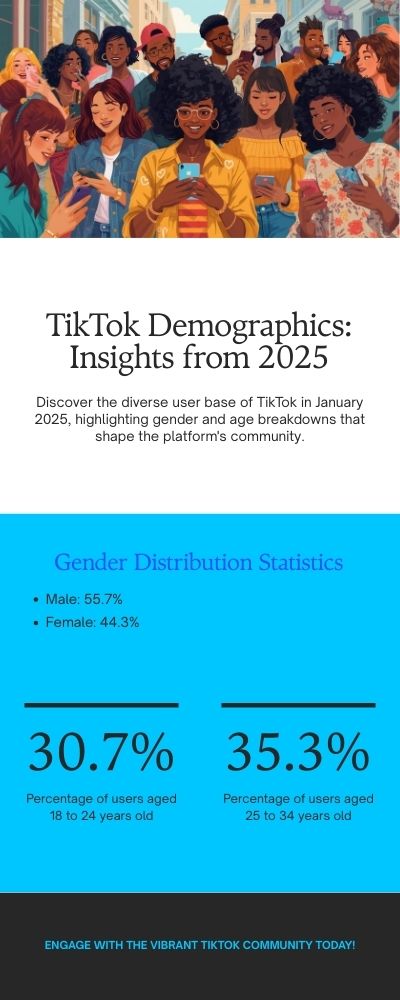
2025 TikTok demographics stats
Gender (Global, Jan 2025)
Age (Global)
- 18 to 24 years old: 30.7%
- 25–34 years old: 35.3%
- 35–44 years old: 16.4%
- 45–54 years old: 9.2%
- 55+ years old: 8.4%
In other words, almost 70% of TikTok users are between the ages of 18 and 34.
Table — TikTok User Demographics (2025)
Age Group% of Global UsersNotes13 – 17~14.0%Teens still significant but no longer dominant.18 – 24~30.7%Strong pool for trendsetting, viral content.25 – 34~35.3%Largest single age cohort — early Millennials with spending power.35 – 44~16.4%Growing adoption of slightly older users.45 – 54~9.2%Smaller but rising segment.55+~8.4%Still modest but increasing over time.Male~55.7%Slight male majority globally.Female~44.3%Close to parity, but males edge ahead.
My analysis
In short, I think these stats paint a picture of a maturing platform. Yes, TikTok has a reputation as a Gen Z platform, but that narrative doesn’t fully hold up anymore.
Now, the largest cohort is aged between 25 and 34 years old. Why is that important? Because 25- to 34-year-olds are at the age when they have buying power and decision-making authority. If brands are still viewing TikTok as solely a platform for teenaged girls doing Renegade dances, they’re getting it wrong.
The split between male and female users is also interesting. While TikTok has a reputation as a beauty and lifestyle platform, an arena dominated by women, globally the platform has a male bias. That’s a clear opportunity, as there’s a gap to be filled by creating content (and ad campaigns) aimed at women outside of beauty and lifestyle verticals.
Here’s what I do know: brands and creators can no longer view TikTok as the “app for teenage girls.” The audience has aged up. There are older Gen Z users, there are millennials, and there’s a more even distribution of interests.
In some markets, content aimed at 25 to 34 year olds might outperform content aimed at teenaged users. Yes, TikTok is a youth-driven platform. But it’s no longer a youth-only platform. Much of the growth will come from broadening the platform’s appeal just beyond its core audience, all while retaining the fast-paced, creative, slightly anarchic spirit that helped the platform take off in the first place.
Average Time Spent on TikTok per User per Day (2019–2025)
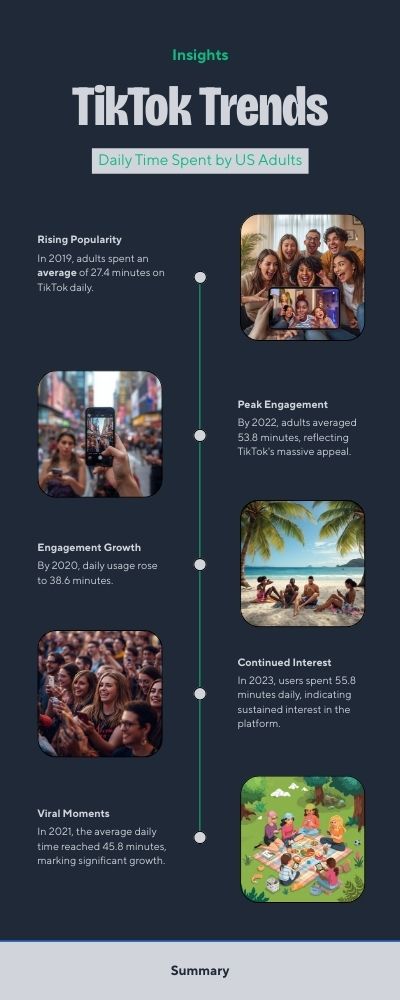
TikTok time spent has not only been high, but also remarkably consistent over the years. We have the most consistent time series data for US adults, which also shows how the app has transitioned from “quick check-ins” to everyday viewing that approaches TV time spent.
Meanwhile, in other countries, time spent has been even greater at various points in time, such as monthly hours spent by Android users in Indonesia leading up to 2025, so time spent globally is, if anything, even greater in certain countries.
Key statistics (US adults)
Daily time spent increased from the high-20s (minutes) in 2019 to the high-50s in 2024, before decreasing slightly to about 52 minutes in 2025. Despite this drop, TikTok will still have more time spent than other major social media platforms.
Average Daily Time on TikTok (US adults, 2019 to 2025)
YearMinutes per user per day201927.4202038.6202145.8202253.8202355.8202458.42025*52.0
*2025 is a forecast. All figures are averages among adult (18+) users of any TikTok, based on Insider Intelligence/eMarketer estimates.
In simpler terms
My takeaway here is less about a “peak” and more about how ingrained a habit the platform has become. The 2019 to 2024 increase coincided with the app’s improving algorithmic recommendations, the increasing popularity of professionalized creators, and the introduction of ecommerce features that incentivize users to spend more time in the app.
The decrease in 2025 likely reflects a normalization of pandemic-era behavior and growing competition for digital video time. At the same time, there are still some countries where usage is much higher; this is another indication that the ceiling for time spent on TikTok varies by country, depending on a range of factors including data plans and integration with ecommerce.
If TikTok can successfully introduce longer-form content without reducing “quick hits,” I would expect time spent to level off at its current elevated base and increase in countries where short-form video still has lots of runway.
TikTok Revenue and In-App Purchases (2020–2025)
TikTok’s revenue trajectory is somewhat fascinating over the past few years. Taking into account the combined revenues of both TikTok and Douyin (TikTok’s Chinese counterpart), you will notice the following trend. First, steady growth. Then, a hockey stick. A significant driver of this hockey stick is in-app purchases (IAPs), which have become a notable contributor to the business in addition to advertising.
Before we dive into the analysis, here are some numbers.
Important Numbers
YearTotal Revenue (US$ billion)Approx. IAP Revenue (US$ billion)Notes20202.6(not specified)Early scale-up stage.20214.8(not specified)Rapid growth post-pandemic.20229.6(not specified)Monetisation broadens.202316.1~4.4IAP figure derived from sensor estimate.202423.0~6.0IAP crosses $6 billion; non-advertising income grows.2025*(Projected) ~33.1 (ads only)(not precisely disclosed)Full total beyond ads likely higher.
* The 2025 number is an estimate
Analysis
There are two key takeaways from these numbers.
The first is that the advertising business is massive. An 8x increase in 4 years is nothing to sneeze at, particularly when you consider how competitive the digital advertising space is. (The digital ad pie is dominated by Google, Facebook and a few other players). A revenue increase of this magnitude suggests one thing: Users are spending a ton of time on the platform and advertisers want to be where the eyeballs are.
The second (and more intriguing) takeaway is the growth of IAPs. The fact that IAPs totaled $6B in 2024 suggests that users are not just consuming content. They are also spending money within the ecosystem. Whether that money is spent on tips, coins, virtual gifts, etc. is somewhat immaterial. The fact that users are willing to spend money period is what matters.
As a result, TikTok may be transitioning from an attention economy to an engagement economy. In the former, users merely consume content. In the latter, they spend money to engage with it.
Going forward, the important metric is not necessarily overall revenue. It is the revenue mix. If TikTok can maintain a robust advertising business while continuing to grow IAPs and social commerce, it will be less reliant on ad spend. This revenue diversification will serve the company well if it encounters future economic headwinds.
Of course, there are risks to this business. From a regulatory perspective, increased scrutiny (particularly in large markets like the United States) could impact the advertising business. And from a user standpoint, there is always the risk of payment fatigue. (That is, users may become tired or annoyed at the constant suggestions to tip, buy coins, etc.).
From the perspective of brands, creators and observers of the platform, the question is not how large the revenue stream is, but where it is coming from. If tipping, virtual goods and social commerce continue to increase, creators who are able to effectively monetize via these channels may capture an outsized portion of the value.
Put differently, not only is TikTok getting bigger. It is also becoming more diversified in its revenue streams. And this diversification may be just as important as the growth itself.
TikTok App Downloads and Market Share (2025 YTD)
When I examine where TikTok stands in terms of recent downloads and market share, two things become clear: the app continues to attract significant traction, and yet the competitive landscape is shifting.
Here’s the latest on download volumes and how TikTok is positioned among the broader app ecosystem as of 2025 year-to-date.
Key Statistics
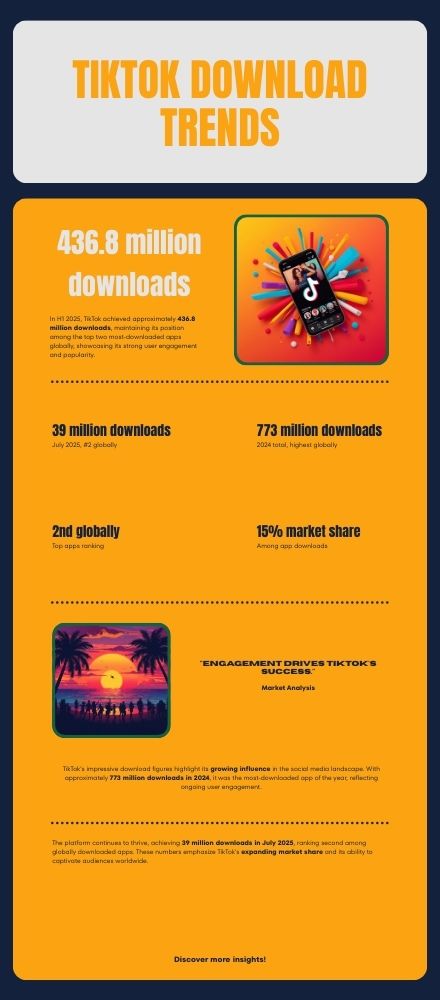
- In July 2025 alone, TikTok recorded approximately 39 million downloads globally across iOS and Android, making it the second most-downloaded app worldwide that month (behind ChatGPT).
- In the first half of 2025, TikTok surpassed 436.8 million downloads worldwide.
- In terms of market share among social apps by download volume, TikTok continues to rank at or near the top for 2025, though it has ceded the top spot in some months to newer challengers.
Table — TikTok Downloads & Relative Market Share (2025 YTD)
Time-PeriodApproximate Downloads (Worldwide)Noted Global Rank / Market Share ContextH1 2025~436.8 millionAmong top 2 globally across all appsJuly 2025 (single month)~39 million#2 globally for most-downloaded apps2024 full year~773 millionHighest-downloaded app in 2024
My perspective as an analyst
From my vantage point, the data signals that TikTok remains very much a download powerhouse—but slightly less untouchable than in prior years.
The ~436 million downloads in the first half of 2025 indicate strong demand, and the July figure (~39 million) shows it still draws substantial monthly volume.
However, the fact that it is not always the top downloaded app (e.g., ChatGPT outran it in July) suggests competitive pressure and possibly shifting user attention.
What I find particularly interesting: high download volumes do not automatically guarantee expansion of active user base or engagement.
Given regulatory headwinds (notably in the U.S. and some European jurisdictions), TikTok’s challenge may increasingly be about retention, monetisation, and regional growth, rather than simply new installs.
In practical terms, brands and creators should interpret strong download numbers as a baseline of opportunity—but they must also pay attention to which markets are driving those installs, and whether the user base in those markets is sticking and engaging.
In short: TikTok remains a dominant force in downloads and market presence, but the era of undisputed download dominance may be evolving.
The next phase, in my view, will hinge on converting those downloads into deeper engagement, especially in emerging markets and across longer-term user cohorts.
TikTok Engagement Metrics (2025)
When examining how users interact with TikTok in 2025, the engagement landscape reveals both strength and subtle shifts.
Engagement remains a core advantage of the platform, yet nuances—such as account size and industry type—are shaping how interaction levels are experienced.
Key engagement statistics
- Platform-wide average engagement rate (by follower count) in 2025: about 2.88% for accounts with over 10 million followers; for those under 100 k followers, engagement rates rise to approximately 7.50%.
- According to benchmark studies: For many brands and industries on TikTok the average is near 4.86%, though it has dropped from ~5.14% in January 2024 to ~4.56% in January 2025.
- Industry-specific performance: In a recent survey, publishing brands achieved an average engagement of 5.2%, while other sectors (e.g., Beauty, Luxury) landed more in the 3-4% range.
Table — TikTok Engagement Benchmarks (2025)
Account Type / MetricApproximate Engagement RateAccounts < 100 k followers~7.50%Accounts 100 k–500 k followers~5.10%Accounts 500 k–1 M followers~4.48%Accounts 1 M–5 M followers~3.76%Accounts > 10 M followers~2.88%Benchmark average across many brands / posts~4.86%Industry best (publishing brands)~5.20%
Analyst’s perspective
From my vantage point, the engagement numbers reaffirm something I’ve observed: TikTok continues to offer unusually strong interaction—especially for smaller, niche accounts—compared to many other social platforms.
That the < 100 k follower accounts can hit ~7.5% suggests the algorithm still rewards authenticity and community focus.
However, the downward drift in average benchmarks (e.g., from ~5.14% to ~4.56% for some metrics) signals a maturing platform.
As more brands, creators and paid campaigns enter the space, the “easy” wins may become fewer.
Larger accounts (>10 M followers) seeing engagement around ~2.9% also points to the fact that scale brings its own challenge: maintaining highly engaged communities at huge size is harder.
For brands and creators, that means the following: if you’re aiming for highest possible engagement rates, smaller-to-mid sized accounts may offer disproportionate value.
If you’re a large brand, expect the engagement rate to sit lower—but compensate by reach, frequency and paid support.
In short: TikTok engagement remains a material asset, but strategy needs to adjust from “grow big fast” to “grow relevant and engaged.”
TikTok’s 2025 data paints a portrait of a platform that has achieved maturity without losing momentum.
User growth has slowed compared to its explosive early years, yet overall engagement, regional expansion, and monetization remain robust.
The platform now commands over a billion active users, spanning regions from North America to South-East Asia, each contributing to an ecosystem that blends entertainment, commerce, and community in unique ways.
What stands out most, in my analysis, is the depth of TikTok’s connection with its users.
People are not just visiting the app—they’re living inside it for hours a day, spending money, engaging with creators, and reshaping pop culture in real time.
At the same time, the metrics show that TikTok is entering a more competitive era: rival apps are capturing new downloads, regulators are imposing tougher scrutiny, and user demographics are diversifying.
Still, TikTok’s balance of creativity, algorithmic precision, and global reach remains unmatched.
If 2025 proves anything, it’s that TikTok is no longer a fleeting trend but a fixture of the modern digital economy—a platform whose data tells a story of adaptation, influence, and enduring relevance.
Sources and References
- Reuters – Company-reported TikTok user milestones from 2018 to 2021 (Global TikTok User Growth 2018–2025).
- DemandSage – Compiled global TikTok user data for 2023–2025 (Global TikTok User Growth 2018–2025).
- Analyzify – 2025 TikTok user counts by country (TikTok Users by Country 2025).
- Castmagic.io – Regional TikTok user numbers and market comparisons (TikTok Users by Country 2025).
- DataReportal – Global TikTok ad audience data and regional breakdowns (TikTok Penetration Rate by Region 2025).
- Reuters – TikTok’s 2025 European user figures (TikTok Penetration Rate by Region 2025).
- DesignRush – Global TikTok age distribution (TikTok Demographics: Age and Gender Breakdown 2025).
- Buffer – Gender and age breakdown of TikTok users (TikTok Demographics: Age and Gender Breakdown 2025).
- Insider Intelligence / eMarketer – Average daily time spent per user (2019–2025) (Average Time Spent on TikTok per User per Day 2019–2025).
- DataReportal – Country-level app usage insights (Average Time Spent on TikTok per User per Day 2019–2025).
- Business of Apps – Global TikTok revenue statistics (TikTok Revenue and In-App Purchases 2020–2025).
- Sensor Tower – TikTok in-app purchase revenue estimates (TikTok Revenue and In-App Purchases 2020–2025).
- NewswireJet – 2025 projected TikTok ad revenue (TikTok Revenue and In-App Purchases 2020–2025).
- AppFigures – 2025 YTD TikTok download totals (TikTok App Downloads and Market Share 2025 YTD).
- The Influencer Marketing Factory – Engagement rate benchmarks by follower count (TikTok Engagement Metrics 2025).
- Buffer – Platform-wide engagement rate trends (TikTok Engagement Metrics 2025).
- Dash Social – Industry-specific engagement benchmarks (TikTok Engagement Metrics 2025).