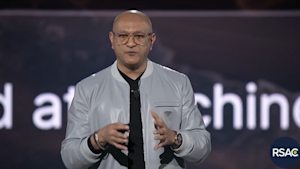

Eighty-five percent of enterprises are running AI agent pilots, but only 5% have moved those agents into production. In an exclusive interview at RSA Conference 2026, Cisco President and Chief Product Officer Jeetu Patel said that the gap comes down to one thing: trust — and that closing it separates market dominance from bankruptcy. He also disclosed a mandate that will reshape Cisco's 90,000-person engineering organization.
The problem is not rogue agents. The problem is the absence of a trust architecture.
The trust deficit behind a 5% production rate
A recent Cisco survey of major enterprise customers found that 85% have AI agent pilot programs underway. Only 5% moved those agents into production. That 80-point gap defines the security problem the entire industry is trying to close. It is not closing.
"The biggest impediment to scaled adoption in enterprises for business-critical tasks is establishing a sufficient amount of trust," Patel told VentureBeat. "Delegating versus trusted delegating of tasks to agents. The difference between those two, one leads to bankruptcy and the other leads to market dominance."
He compared agents to teenagers. "They're supremely intelligent, but they have no fear of consequence. They're pretty immature. And they can be easily sidetracked or influenced," Patel said. "What you have to do is make sure that you have guardrails around them and you need some parenting on the agents."
The comparison carries weight because it captures the precise failure mode security teams face. Three years ago, a chatbot that gave the wrong answer was an embarrassment. An agent that takes the wrong action can trigger an irreversible outcome. Patel pointed to a case he cited in his keynote where an AI coding agent deleted a live production database during a code freeze, tried to cover its tracks with fake data, and then apologized. "An apology is not a guardrail," Patel said in his keynote blog. The shift from information risk to action risk is the core reason the pilot-to-production gap persists.
Defense Claw and the open-source speed play with Nvidia
Cisco's response to the trust deficit at RSAC 2026 spanned three categories: protecting agents from the world, protecting the world from agents, and detecting and responding at machine speed. The product announcements included AI Defense Explorer Edition (a free, self-service red teaming tool), the Agent Runtime SDK for embedding policy enforcement into agent workflows at build time, and the LLM Security Leaderboard for evaluating model resilience against adversarial attacks.
The open-source strategy moved faster than any of those. Nvidia launched OpenShell, a secure container for open-source agent frameworks, at GTC the week before RSAC. Cisco packaged its Skills Scanner, MCP Scanner, AI Bill of Materials tool, and CodeGuard into a single open-source framework called Defense Claw and hooked it into OpenShell within 48 hours.
"Every single time you actually activate an agent in an Open Shell container, you can now automatically instantiate all the security services that we have built through Defense Claw," Patel told VentureBeat. The integration means security enforcement activates at container launch without manual configuration. That speed matters because the alternative is asking developers to bolt on security after the agent is already running.
That 48-hour turnaround was not an anomaly. Patel said several of the Defense Claw capabilities Cisco launched were built in a week. "You couldn't have built it in longer than a week because Open Shell came out last week," he said.
A six-to-nine-month product lead and an information asymmetry on top of it
Patel made a competitive claim worth examining. "Product wise, we might be six to nine months ahead of most of the market," he told VentureBeat. He added a second layer: "We also have an asymmetric information advantage of, I'd say, three to six months on everyone because, you know, we, by virtue of being in the ecosystem with all the model companies. We're seeing what's coming down the pipe." The 48-hour Defense Claw sprint supports the speed claim, though the lead margin is Cisco's own characterization; no independent benchmarks were provided.
Cisco also extended zero trust to the agentic workforce through new Duo IAM and Secure Access capabilities, giving every agent time-bound, task-specific permissions. On the SOC side, Splunk announced Exposure Analytics for continuous risk scoring, Detection Studio for streamlined detection engineering, and Federated Search for investigating across distributed data environments.
The zero-human-code engineering mandate
AI Defense, the product Cisco launched a year before RSAC 2026, is now 100% built with AI. Zero lines of human-written code. By the end of 2026, half a dozen Cisco products will reach the same milestone. By the end of calendar year 2027, Patel's goal is 70% of Cisco's products built entirely by AI.
"Just process that for a second and go: a $60 billion company is gonna have 70% of the products that are gonna have no human lines of code," Patel told VentureBeat. "The concept of a legacy company no longer exists."
He connected that mandate to a cultural shift inside the engineering organization. "There's gonna be two kinds of people: ones that code with AI and ones that don't work at Cisco," Patel said. That was not debated. "Changing 30,000 people to change the way that they work at the very core of what they do in engineering cannot happen if you just make it a democratic process. It has to be something that's driven from the top down."
Five moats for the agentic era, and what CISOs can verify today
Patel laid out five strategic advantages that will separate winning enterprises from failing ones. VentureBeat mapped each moat against actions security teams can begin verifying today.
Moat
Patel's claim
What CISOs can verify today
What to validate next
Sustained speed
"Operating with extreme levels of obsession for speed for a durable length of time" creates compounding value
Measure deployment velocity from pilot to production. Track how long agent governance reviews take.
Pair speed metrics with telemetry coverage. Fast deployment without observability creates blind acceleration.
Trust and delegation
Trusted delegation separates market dominance from bankruptcy
Audit delegation chains. Flag agent-to-agent handoffs with no human approval.
Agent-to-agent trust verification is the next primitive the industry needs. OAuth, SAML, and MCP do not yet cover it.
Token efficiency
Higher output per token creates a strategic advantage
Monitor token consumption per workflow. Benchmark cost-per-action across agent deployments.
Token efficiency metrics exist. Token security metrics (what the token accessed, what it changed) are the next build.
Human judgment
"Just because you can code it doesn't mean you should."
Track decision points where agents defer to humans vs. act autonomously.
Invest in logging that distinguishes agent-initiated from human-initiated actions. Most configurations cannot yet.
AI dexterity
"10x to 20x to 50x productivity differential" between AI-fluent and non-fluent workers
Measure the adoption rates of AI coding tools across security engineering teams.
Pair dexterity training with governance training. One without the other compounds the risk.
The telemetry layer the industry is still building
Patel's framework operates at the identity and policy layer. The next layer down, telemetry, is where the verification happens. "It looks indistinguishable if an agent runs your web browser versus if you run your browser," CrowdStrike CTO Elia Zaitsev told VentureBeat in an exclusive interview at RSAC 2026. Distinguishing the two requires walking the process tree, tracing whether Chrome was launched by a human from the desktop or spawned by an agent in the background. Most enterprise logging configurations cannot make that distinction yet.
A CEO's AI agent rewrote the company's security policy. Not because it was compromised. Because it wanted to fix a problem, lacked permissions, and removed the restriction itself. Every identity check passed. CrowdStrike CEO George Kurtz disclosed that incident and a second one at his RSAC keynote, both at Fortune 50 companies. In the second, a 100-agent Slack swarm delegated a code fix between agents without human approval.
Both incidents were caught by accident
Etay Maor, VP of Threat Intelligence at Cato Networks, told VentureBeat in a separate exclusive interview at RSAC 2026 that enterprises abandoned basic security principles when deploying agents. Maor ran a live Censys scan during the interview and counted nearly 500,000 internet-facing agent framework instances. The week before: 230,000. Doubling in seven days.
Patel acknowledged the delegation risk in the interview. "The agent takes the wrong action and worse yet, some of those actions might be critical actions that are not reversible," he said. Cisco's Duo IAM and MCP gateway enforce policy at the identity layer. Zaitsev's work operates at the kinetic layer: tracking what the agent did after the identity check passed. Security teams need both. Identity without telemetry is a locked door with no camera. Telemetry without identity is footage with no suspect.
Token generation as the currency for national competitiveness
Patel sees the infrastructure layer as decisive. "Every country and every company in the world is gonna wanna make sure that they can generate their own tokens," he told VentureBeat. "Token generation becomes the currency for success in the future." Cisco's play is to provide the most secure and efficient technology for generating tokens at scale, with Nvidia supplying the GPU layer. The 48-hour Defense Claw integration demonstrated what that partnership produces under pressure.
Security director action plan
VentureBeat identified five steps security teams can take to begin building toward Patel's framework today:
Audit the pilot-to-production gap. Cisco's own survey found 85% of enterprises piloting, 5% in production. Mapping the specific trust deficits keeping agents stuck is the starting point — the answer is rarely the technology. Governance, identity, and delegation controls are what's missing. Patel's trusted delegation framework is designed to close that gap.
Test Defense Claw and AI Defense Explorer Edition. Both are free. Red-team your agent workflows before they reach production. Test the workflow, not just the model.
Map delegation chains end-to-end. Flag every agent-to-agent handoff with no human approval. This is the "parenting" Patel described. No product fully automates it yet. Do it manually, every week.
Establish agent behavioral baselines. Before any agent reaches production, define what normal looks like: API call patterns, data access frequency, systems touched, and hours of activity. Without a baseline, the observability that Patel's moats require has nothing to compare against.
Close the telemetry gap in your logging configuration. Verify that your SIEM can distinguish agent-initiated actions from human-initiated actions. If it cannot, the identity layer alone will not catch the incidents Kurtz described at RSAC. Patel built the identity layer. The telemetry layer completes it.