
Key Takeaways
- Aave plans to exit six chains and remove 71 markets covering $98.1M in deposits.
- Aave’s $14.5B scale shows DeFi is prioritizing revenue over low-use expansion.
- Aave will shift resources to larger markets and securities finance after six network exits.
Aave Plans 50 Asset Removals as Multichain Costs Rise
Aave is pruning its sprawling multichain lending business, targeting low-activity markets that create more technical and financial risk than revenue.
A governance proposal recommends removing 50 individual asset reserves and 21 matured Pendle principal tokens across 11 deployments. It also calls for the full wind-down of Aave markets on Sonic, Scroll, Aptos, zkSync, Metis, and Soneium.
Together, the changes cover $98.1 million in supplied assets and $15.6 million in outstanding debt. Many affected reserves are already frozen or have sharply reduced deposit and borrowing limits.
Smaller Markets Face Orderly Shutdown
The six network deployments contain 25 reserves with $12.8 million of deposits and $4.1 million of debt, spread across Sonic ($7.6M), Scroll ($2.2M), Aptos ($1.7M), zkSync ($0.8M), Metis ($0.3M), and Soneium ($0.2M). The remaining removals account for $85.3 million in supply and $11.5 million in borrowings.

Under the plan, Aave would freeze the relevant reserves and cut supply and borrowing caps to nominal levels. For markets with active loans, higher reserve factors and interest rates would encourage borrowers to repay and depositors to withdraw.
The proposal said each listed asset carries fixed costs. Those include oracle maintenance, risk monitoring, and reliable liquidation infrastructure. On the six smaller networks, revenue has fallen below the cost of supporting the deployments.
Aave founder Stani Kulechov said the move follows “a comprehensive review” and will reduce the protocol’s “economic and technical risk surface.”
When asked how often Aave conducts such assessments, he replied: “It’s a continuous review.”

Kulechov Says Move Is Not a Verdict on L2s
Kulechov cautioned against treating the exits as criticism of the affected blockchains.
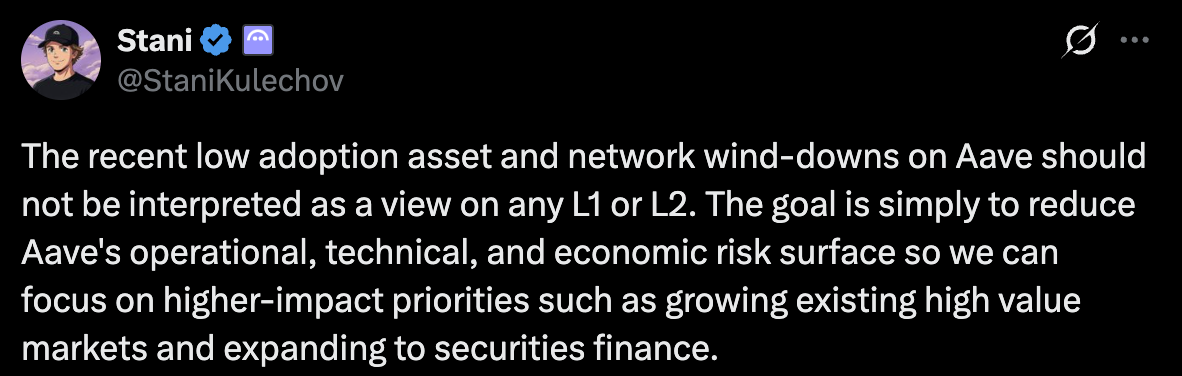
“The recent low adoption asset and network wind-downs on Aave should not be interpreted as a view on any L1 or L2,” he said.
Instead, Aave plans to direct resources toward established markets and new areas such as securities finance. Kulechov also said layer-2 networks remain important to Ethereum’s user experience. He pointed to their potential role in consumer-facing products, while highlighting Avalanche’s work with tokenized real-world assets.
The overhaul follows Aave’s adoption of broader risk and technical listing frameworks. Those standards require continuous monitoring and allow the protocol to reconsider assets or entire deployments when activity, liquidity or infrastructure no longer meets its requirements.
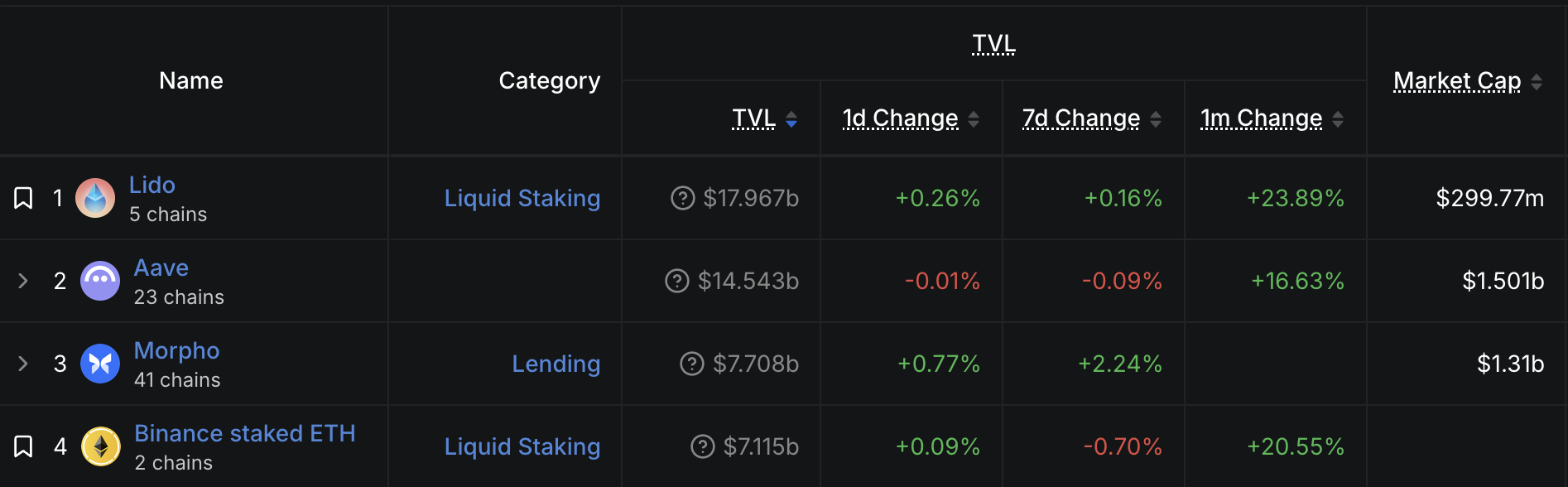
Aave remains the largest decentralized lending protocol by total value locked. It holds about $14.5 billion across 23 blockchains, according to DefiLlama.
The retreat shows that being everywhere is no longer Aave’s priority. The protocol is choosing concentration over expansion as it prepares for its next phase of growth.