


The deployment of autonomous AI agents—systems capable of using tools and executing code—presents a unique security challenge. While standard LLM applications are restricted to text-based interactions, autonomous agents require access to shell environments, file systems, and network endpoints to perform tasks. This increased capability introduces significant risks, as a model’s ‘black box’ nature can lead to unintended command execution or unauthorized data access.
NVIDIA has addressed this gap by open-sourcing OpenShell, a dedicated runtime environment designed to facilitate the safe execution of autonomous agents. Released under the Apache 2.0 license, OpenShell provides a framework for sandboxing, access control, and inference management.
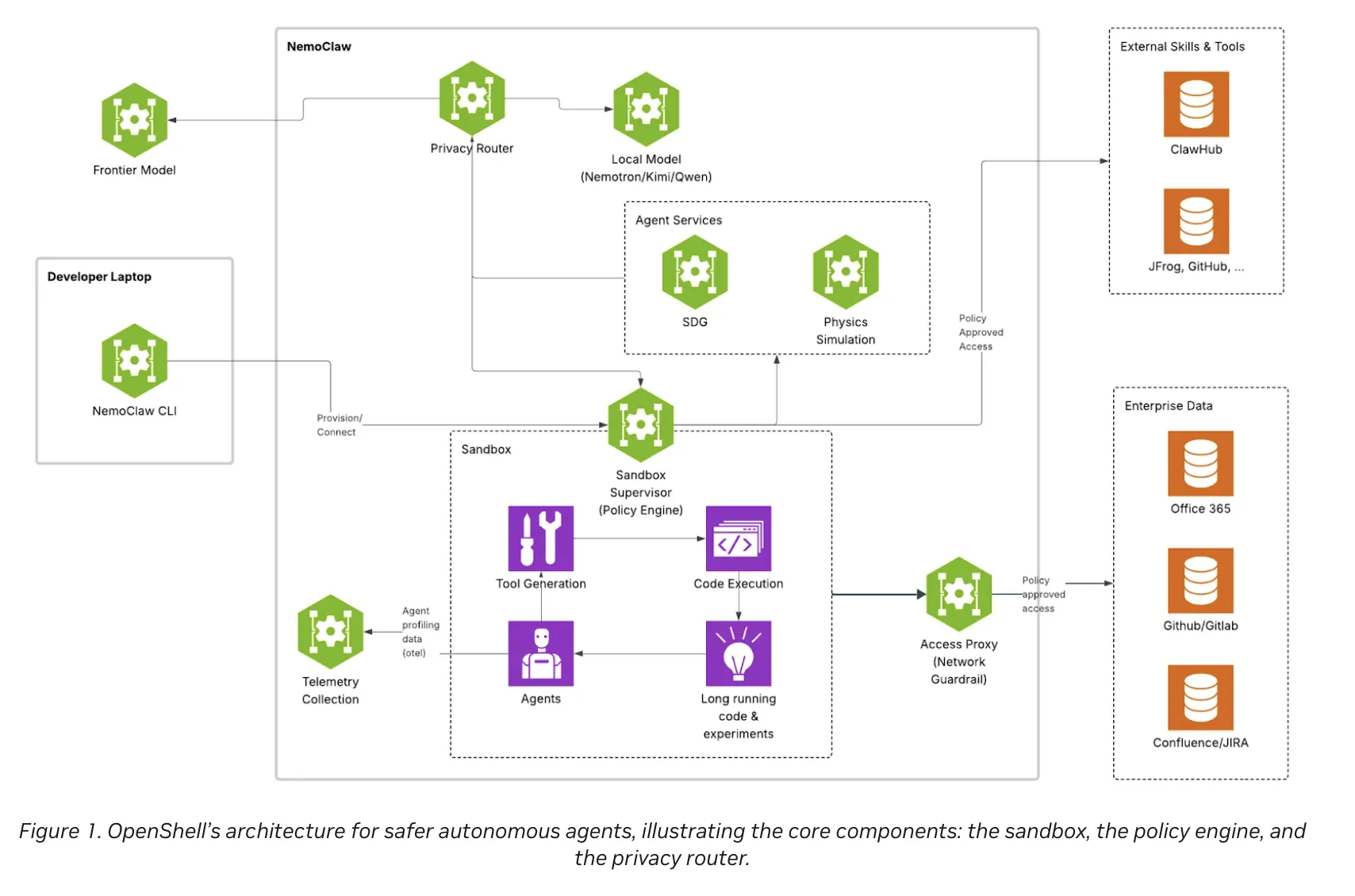
The Architecture of Agent Safety
OpenShell functions as a protective layer between the AI agent and the operating system. For AI devs, this means the agent’s ‘tool-use’ capabilities are restricted by a predefined security posture rather than relying on the model’s internal alignment.
1. Sandboxed Execution
OpenShell utilizes kernel-level isolation to create an ephemeral execution environment. By sandboxing the agent, any code generated—whether it is a Python script or a Bash command—is executed within a restricted space. This prevents an agent from accessing sensitive host files or modifying system configurations unless explicitly permitted.

2. Policy-Enforced Access Control
OpenShell’s governance core is its granular policy engine. Unlike traditional container security, which often operates on broad permissions, OpenShell allows for:
- Per-binary control: Restricting which executables (e.g., git, curl, python) the agent can invoke.
- Per-endpoint control: Limiting network traffic to specific IP addresses or domains.
- Per-method control: Governing specific API calls or shell functions.
These policies are ‘explainable,’ meaning every action is logged in an audit log. This provides a clear trail for debugging and compliance, allowing devs to verify exactly why a specific action was blocked or permitted.
3. Private Inference Routing
OpenShell includes a dedicated layer for private inference routing. This mechanism intercepts model traffic to enforce privacy and cost constraints. It ensures that sensitive data is not leaked to external model providers and allows organizations to switch between local and cloud-based LLMs without modifying the agent’s core logic.
Agent Agnostic Integration
A key technical advantage of OpenShell is that it is agent agnostic. It does not require developers to rewrite agents using a specific SDK or framework. Whether a team is utilizing Claude Code, Codex, OpenClaw, or a custom LangChain-based system, OpenShell acts as a runtime wrapper. This allows for a consistent security layer across diverse agent architectures.
Developer Workflow and CLI
OpenShell is designed for integration into existing CI/CD pipelines and local development environments. It provides a Command Line Interface (CLI) and a Terminal UI (TUI) for real-time monitoring of agent behavior.
Engineers can initialize a sandbox using simple commands:
openshell sandbox create — <agent_name>
# Enter the sandbox terminal to monitor or interact
openshell term
The runtime also supports live policy updates. If an agent requires additional permissions during a task, devs can adjust the policy file without restarting the sandbox, and the changes are applied immediately.
Remote Sandbox Support
For distributed teams or heavy compute workloads, OpenShell supports remote execution. This allows a developer to manage a sandbox running on a high-performance GPU cluster from a local terminal:
Summary of Key Highlights
OpenShell is a foundational tool for anyone building autonomous agent systems that require real-world tool access. By standardizing the runtime, NVIDIA is helping the industry move past experimental scripts toward secure, governed autonomous agents.
Check out Codes, Docs and Technical details. Also, feel free to follow us on Twitter and don’t forget to join our 120k+ ML SubReddit and Subscribe to our Newsletter. Wait! are you on telegram? now you can join us on telegram as well.