


SOL touched $64.56 intraday on June 25 before recovering toward $66.56 as Bitcoin fell to $58,189. Fed hike odds for September held above 60% after the PCE print, and tight liquidity kept the broader market locked out of high-beta crypto rotation.
Solana still ranked third among all blockchains by 30-day net bridge inflows, with roughly $137 million flowing to the network, while tokens based on its blockchain gained ground in the same period.
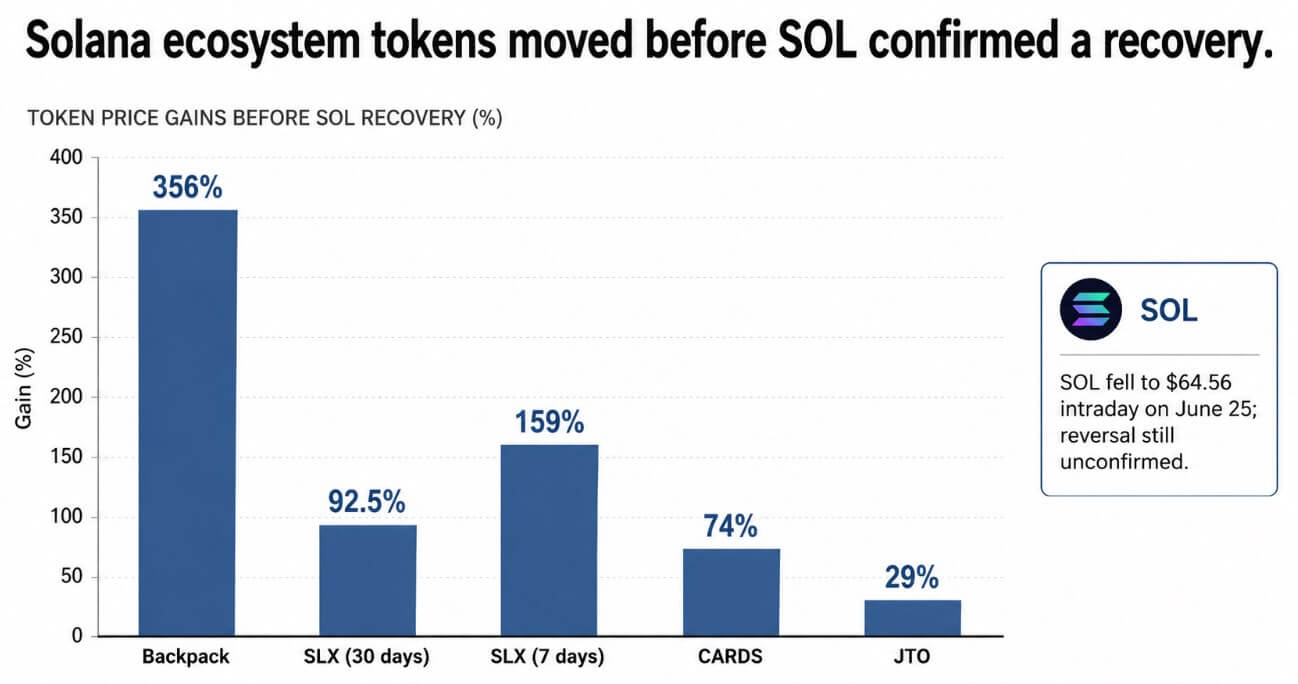
Backpack gained 356%, Solstice’s SLX climbed 92.5% over 30 days and nearly 159% over the past seven days, CARDS rose 74%, and JTO added 29%. Those moves show traders are already expressing Solana recovery risk through smaller network tokens, with SOL’s own reversal still unconfirmed.
Jake Kennis, senior research analyst at Nansen, said SOL’s earlier bounce off June 19 lows, combined with daily volumes holding above $4 billion and roughly $140 million in monthly chain inflows, pointed toward sustained interest.

SOL has since given back those gains and made new lows, which Kennis acknowledged makes the durability question harder to answer.
For a broader Solana recovery to hold, he said, winners inside the network need to reinvest in the chain, broadening on-chain performance beyond a handful of isolated token moves.
The macro gate
BTC traded between $58,189 and $61,844 on June 25, as the odds of a September hike held above 60% even after the in-line PCE print.
That backdrop keeps a broad, sustained Solana rotation out of reach for now, as high-beta assets need risk-on conditions to sustain gains, and the Fed’s hawkish path hasn’t delivered them.
Ryan Lee, chief analyst at Bitget Research, said FTX-related asset sales, tighter market liquidity, and HYPE’s sudden surge have collectively weighed on altcoin capital rotation.
Lee called those market frictions, arguing that they leave Solana’s high-throughput architecture and DeFi activity intact, but they still set the ceiling for any near-term rally.
FactorCurrent signalImpact on Solana Summer thesisBitcoinFell to $58,189 on June 25Broad crypto risk appetite still fragileSOLTouched $64.56 intradayBase asset has not confirmed ecosystem strengthSeptember hike oddsAbove 60%Keeps liquidity tight and weighs on high-beta crypto30-day Solana bridge inflows~$137MShows capital is still entering the networkDaily SOL volumeAbove $4B, per Nansen commentarySuggests interest is not fully disappearingHYPE rotationCapturing high-beta altcoin demandCompetes with Solana ecosystem tokensFTX-related salesOngoing supply overhangCaps near-term sentimentRequired confirmationBTC above $60K; SOL above $70Needed before “Solana Summer” becomes credible
HYPE has captured the high-beta altcoin rotation that Solana-adjacent tokens would typically absorb in a risk-on move, and the FTX supply overhang continues to weigh on sentiment.
Backpack’s 356% move, SLX’s 159% over seven days, CARDS at 74%, and JTO at 29% all preceded any clean SOL reversal, so traders positioned in higher-beta network tokens first, with SOL’s own confirmation still pending.
After the memecoin casino
Pump.fun’s daily revenue fell from around $4.8 million six months ago to about $800,000 in June, and its seven-day average token graduation rate dropped to 0.26%, an 80% decline over three months.
Ben Nadareski, CEO and co-founder of Solstice, said Solana apps still generate about $2.8 million a day in revenue despite that, over double Hyperliquid’s and roughly 2.5 times Ethereum’s.
Capital kept flowing into the network while the casino emptied, and Nadaresk sees this disconnect as showing Solana’s fee base now runs on application revenue.
Collector Crypt, which sells tokenized Pokémon cards, generated about $4 million in revenue last week, with over 30% of buyers redeeming the physical card. Meteora and Backpack produce fee revenue from trading and exchange infrastructure.
Tokenized equities on Solana count more than 170,000 holders and half a billion dollars in assets, with most trading volume occurring outside US market hours.
SpaceX is Nadareski’s example: buyers seeking exposure to the firm’s stocks found it on-chain because no standard brokerage offers it.
Solana’s May roundup reported $2.8 billion in RWA value on the network, 97% of the cumulative on-chain spot trading volume for tokenized equities, and $16.4 billion in stablecoin supply.
Blockworks data put spot trading volume for tokenized assets was nearly $3 billion in June, almost triple the $1 billion recorded in May.
Nadareski argued that the tokens are following application traction this time, in the right order, and inflows are the last to show up.
Solana activity signalData pointWhy it mattersPump.fun daily revenueDown from ~$4.8M to ~$800KMemecoin speculation has cooled sharplyPump.fun graduation rate0.26%, down 80% over 3 monthsFewer launches are turning into tradable winnersSolana app revenue~$2.8M per dayApps are still producing revenue despite memecoin slowdownCollector Crypt revenue~$4M last weekConsumer/RWA use case with real paymentsCollector Crypt redemptions30%+ of buyers redeem physical cardsShows on-chain demand linked to off-chain utilityTokenized equities holders170,000+RWA adoption is broadeningTokenized equities assets~$500MIndicates meaningful capital formationSolana RWA value$2.8BSupports non-memecoin network demandStablecoin supply$16.4BLiquidity base for on-chain activityTokenized asset spot volumeNearly $3B in June vs. $1B in MayShows accelerating RWA trading activity
The setup
If Bitcoin closes below $58,000, bridge inflows will reverse quickly. FTX supply overhang, tighter liquidity, and HYPE’s dominance in the high-beta altcoin rotation are still active headwinds.
21Shares has argued that Solana’s value-capture structure channels most economic returns to applications, leaving SOL’s price gains to depend on separate demand drivers beyond app revenue alone.
SOL needs to reclaim $70, and Bitcoin needs to hold above $60,000 before the network’s inflows and app revenue convert from latent potential into a confirmed trend.
A Solana Summer requires Bitcoin to stabilize, September hike odds to ease, and bridge inflows to persist long enough to broaden from network token speculation into sustained SOL demand.
Solana enters that wait with $137 million in 30-day inflows, $2.8 million in daily app revenue, 97% of tokenized equity spot volume, and a basket of network tokens already pricing in recovery, a stronger pre-conditions profile than most chains can show during a downturn.
If macro turns, Solana has a specific and data-backed claim to lead the next high-beta rotation. If macro stays hostile, inflows and token moves will look like early positioning the market wasn’t ready to absorb.